Antimicrobial Flow Devices
by Neoperl®
Every time a faucet is turned off a few drops of water are trapped inside the aerator (or laminar device) where they stagnate, warm up and eventually evaporate, leaving a film of scale - a source of food for
biofilm. To produce an aerated stream with up to 50% air (white and soft to the touch) air and water are mixed in the faucet aerator's mixing chamber. Most aerators draw air into the water stream, which can be a concern in healthcare institutions because the air is collected from the room around the faucet, and sometimes that air contains bacteria.
When laminar aerators are used, air is not collected and drawn into the water stream, giving you a crystal clear stream of 100% water. Antimicrobially protected faucet attachments offer even more protection by incorporating the natural protection of silver, which prevents the growth of a broad range of microorganisms. By utilizing
Agion® Antimicrobial technology, the laminar flow devices offered below deliver that extra built-in protection to help reduce the growth of bacteria, mold and mildew within the faucet attachment. Replace your current aerator with a laminar flow device and you'll feel better knowing you are getting cleaner water from your tap. The innovative screenless technology provides durable, dependable service, and with little build up. Let PlumbingSupply.com
® be your source for these and thousands of other products.
click any of the flow rates below to be directed to that section
Choosing the Right Aerator
1. Determine whether your faucet spout is female or male threaded. Female-threaded spouts have their threads inside the end of the spout; male threads are found on the outside of the spout. If your faucet has female threads, you'll need a male threaded aerator. If your faucet has male threads, you'll need a female threaded aerator.
2. Now, you'll need to find out what size aerator you require. The easiest way to do so is by grabbing some spare change: a quarter, nickel, and dime. You'll compare these coins to the size of the threaded end of your existing aerator (or the outlet of the faucet spout itself).
- A Regular/Standard size aerator (aka 15/16" x 27 thread Male or 55/64" x 27 thread Female) will be roughly the diameter of a quarter
- A Junior size aerator (aka 13/16" x 27 thread Male or 3/4" x 27 thread Female) will be roughly the diameter of a nickel
Please note: the quarter, nickel, and dime are all approximate measurements. Before placing your order please double check your thread sizing. Some faucet brands use custom sizes, so if you know the manufacturer of the faucet, you can contact them for the exact aerator size.
CareGuard Aerators with Built-In Agion® Antimicrobial Product Protection
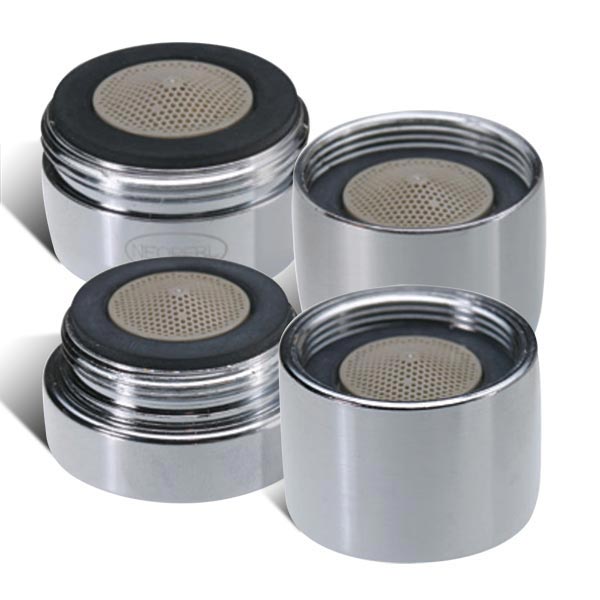
Features:
- Low flow (.35 GPM - 1.8 GPM) saves water and energy
- Agion antimicrobial protection provides a splash-free, crystal clear (or spray) non-aerated stream
- Unique screenless construction to prevent lime build up (no wire mesh screens) and helps to prevent mixing air and water
- Durable single piece insert ensures a longer useable life
- Unique screenless plastic construction to help prevent lime build up
- Great for use in healthcare facilities such as: hospitals, senior care, medical labs, or at home
- Laminar Flow: Laminar stream devices produce a crystal clear, non-aerated, non-splashing water stream. Ideal for high flow applications, or healthcare, day care, and patient care facilities
- Spray Flow: The 0.35 and .5 GPM aerators feature a pressure compensating ability which maintains constant low flow of water, while it's spray pattern minimizes splashing. The spray pattern consists of a ring of mini laminar streams that make them ideal for public restrooms and hospital restrooms
Ultimate Low Flow 0.35 GPM Aerators and Inserts
Regular Ultimate Low Flow 0.35gpm Aerators
(approximately 10.7 seconds to fill 8oz glass)
Vandal-Resistant Ultimate Low Flow 0.35gpm Aerators
(approximately 10.7 seconds to fill 8oz glass)
Insert Only Ultimate Low Flow 0.35gpm Aerators
(approximately 10.7 seconds to fill 8oz glass)
Ultra Low Flow 0.5 GPM Aerators and Inserts
Regular Ultra Low Flow 0.5gpm Aerators
(approximately 7.5 seconds to fill 8oz glass)
Vandal-Resistant Ultra Low Flow 0.5gpm Aerators
(approximately 7.5 seconds to fill 8oz glass)
Insert Only Ultra Low Flow 0.5gpm Aerators
(approximately 7.5 seconds to fill 8oz glass)
Low Flow 1.0 GPM Aerators and Inserts
Regular Low Flow 1.0gpm Aerators
(approximately 3.75 seconds to fill 8oz glass)
Vandal-Resistant Low Flow 1.0gpm Aerators
(approximately 3.75 seconds to fill 8oz glass)
Insert Only Low Flow 1.0gpm Aerators
(approximately 3.75 seconds to fill 8oz glass)
California Economy Flow 1.2 GPM Aerators and Inserts
Regular California Economy Flow 1.2gpm Aerators
(approximately 3.13 seconds to fill 8oz glass)
Vandal-Resistant California Economy Flow 1.2gpm Aerators
(approximately 3.13 seconds to fill 8oz glass)
Insert Only California Economy Flow 1.2gpm Aerators
(approximately 3.13 seconds to fill 8oz glass)
Economy Flow 1.5 GPM Aerators and Inserts
Regular Economy Flow 1.5gpm Aerators
(approximately 2.5 seconds to fill 8oz glass)
Vandal-Resistant Economy Flow 1.5gpm Aerators
(approximately 2.5 seconds to fill 8oz glass)
Insert Only Economy Flow 1.5gpm Aerators
(approximately 2.5 seconds to fill 8oz glass)
California Standard Flow 1.8 GPM Aerators and Inserts
Regular California Standard Flow 1.8gpm Aerators
(approximately 2.1 seconds to fill 8oz glass)
Vandal-Resistant Economy Flow 1.8gpm Aerators
(approximately 2.1 seconds to fill 8oz glass)
Related Items & Information
What is an Aerated Stream?
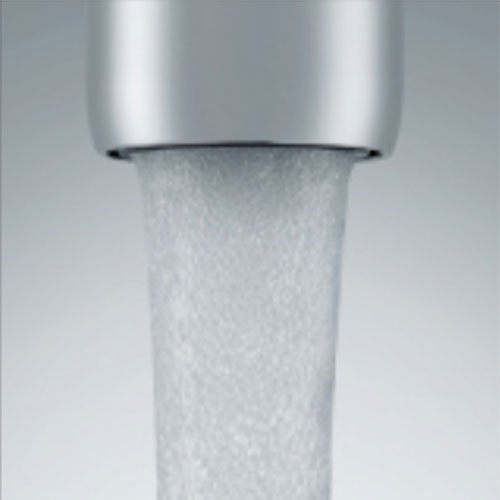
Faucet Aerators introduce air into the water stream to produce a larger, fuller, whiter, softer and non-splashing water stream.
Applications:
- Residential
- Office Kitchen
What is a Laminar Stream?
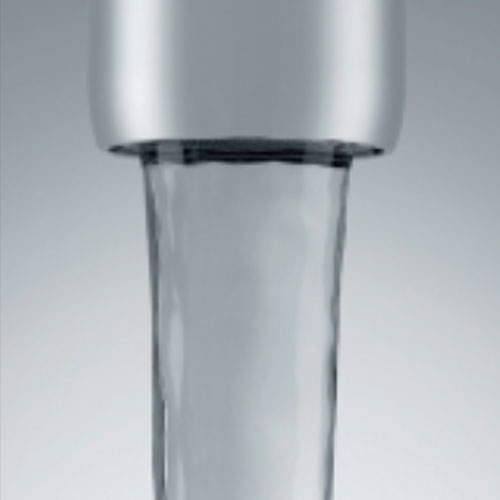
Laminar stream straighteners produce a non-aerated, crystal clear and non-splashing water stream.
Applications:
- Hospital
- Daycare
- Patient Care
What is a Spray Stream?

Spray device is a multiple needle like laminar stream used when the flow rate is to low to provide a full coverage of the hands during washing.
Applications:
- Public Restroom
- Hospital Restrooms
Frequently Asked Questions
Q. "What is Agion® Antimicrobial product protection?"
A. Agion® helps prevent the formation of biofilm on spout ends. To prevent biofilms from forming, the Agion® compound within the Careguard® inhibits the initial colonization with a tri-modal efficacy unique to silver. What this means is that it attacks the bacterial cell wall, interrupts cell metabolism, and prevents bacteria reproduction.
Q. "What is Biofilm?"
A. Biofilm is a community of microbes that attach to surfaces. After initial colonization, the biofilm creates a "barrier" to protect the bacteria's environment thus allowing microbes to multiply. Various factors can increase the risk of colonization and bacterial growth: warm water, water stagnation (such as in a pipework dead-leg zone) and nutrients (scale, sediment).
Q. "How do these prevent vandalism?"
A. The exposed body spins freely preventing simple unthreading and unauthorized removal. A special key is needed to install or remove the aerator.
Q. "What do you mean by 'no added air, 100% water' ?"
A. Standard aerators allow air to mix with the water as it flows out from the spout to achieve a soft to the touch, white appearance that most residential users are accustomed to. Laminar devices are designed to not allow any air surrounding the outlet into the flow of water. This helps prevent any air possibly containing bacteria from entering the water stream.
Q. "I purchased a 1.8 gpm aerator and the packaging itself indicates 1.8 gpm. However, I noticed the aerator product itself has 1.75 gpm impressed into the metal. Which GPM notation is correct?"
A. Technically speaking, the flow rate is 1.75 gpm and has been rounded up to show 1.8 gpm on the packaging. When the state of California enacted The Water Conservation Act of 2009, they were required to reduce water consumption by 20%, reducing their maximum flow from 2.2 gpm to 1.75 gpm. The manufacturer started making their aerators 1.75 gpm to be compliant with California's law. However, California chose to round the 1.75 gpm figure to 1.8 gpm maximum flow rate (and several other states followed suit in reducing their maximum flow rates to match these figures). The manufacturer did not want to confuse their suppliers and opted to label the bag as 1.8 gpm and laser mark the housing as 1.75 gpm, rather than make two entirely different products when there is actually very little variation between them.
return to top ↑
