Water Shut-off Valves
These valves are 2014 Federal Safe Drinking Water Act compliant
You'll find one of the best selections of angle and straight stops at PlumbingSupply.com®! Available in many different configurations. The perfect solution to your supply needs is right here. Compression, IPS, and even dual or 3-way stops are offered and can ship out the same day you order in most cases. Let us be your source for stop valves for any job.
click any of the images below to be directed to that section
Angle Stops
Most often used for connecting wall stubouts to supply lines for a fixture, such as a toilet or faucet, an angle stop provides an easy way to turn off the water to just that fixture instead of the entire house.
1/2" FIPS Inlet Angle Stops
Polished Chrome Plated
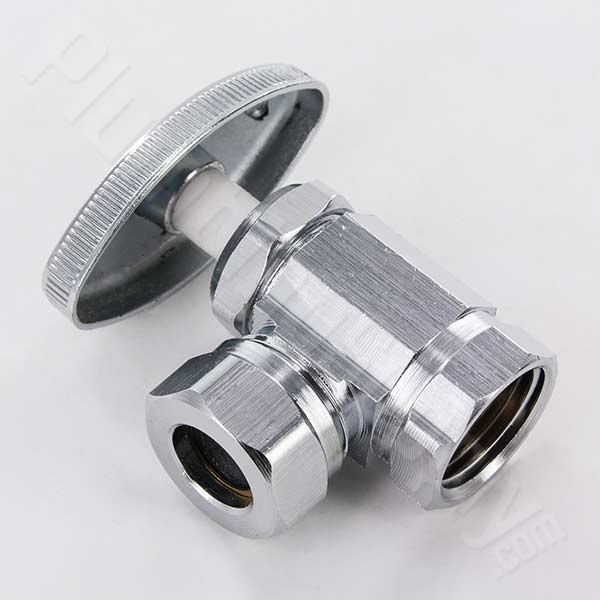
1/2" FIP x 1/2" & 7/16" (slip joint)
Compression Angle Stop Valve

1/2" FIP x 1/4" OD Comp
Compression Angle Stop Valve

1/2" FIP x 3/8" OD Comp
Compression Angle Stop Valve
5/8" OD Compression Inlet Angle Stops
Polished Chrome Plated - for 1/2" Nominal Copper Pipe

5/8" OD Comp x 3/8" OD Comp
Quarter Turn Angle Stop Valve

5/8" OD Comp x 1/2" OD Comp
Quarter Turn Angle Stop Valve

5/8" OD Comp x 1/2" & 7/16" S.J.
Quarter Turn Angle Stop Valve
3/8" FIPS Inlet Angle Stops
Polished Chrome Plated

3/8" FIPS x 3/8" OD Comp
Quarter Turn Angle Stop Valve

3/8" FIPS x 3/8" OD Comp
Quarter Turn Angle Stop Valve
Create a branch outlet on a supply stop without shutting off the main water supply with a Quick Tee Adapter
Straight Stops
Pipe stubouts extending from the floor typically utilize straight stops for connecting to supply lines. Having a stop near a fixture allows the water to be turned off for just that fixture without disrupting the water flow to the rest of a home or business.
1/2" FIPS Inlet Straight Stops
Polished Chrome Plated

1/2" FIPS x 3/8" OD Comp
Compression Straight Stop Valve

1/2" FIPS x 3/8" OD Comp
Quarter Turn Straight Stop Valve

1/2" FIPS x 1/2" S.J. (slip joint)
Compression Straight Stop Valve
5/8" OD Compression Inlet Straight Stops
Polished Chrome Plated - for 1/2" Nominal Copper Pipe
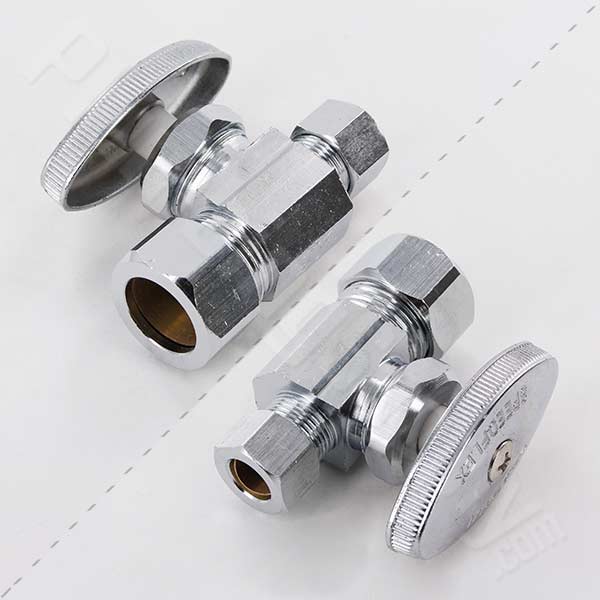
5/8" OD Comp x 3/8" OD Comp
Compression Straight Stop Valve

5/8" OD Comp x 3/8" OD Comp
Quarter Turn Straight Stop Valve
Create a branch outlet on a supply stop without shutting off the main water supply with a Quick Tee Adapter
Double Handle Angle Stops
Two independent outlets from one inlet allows you to provide water to both outlets at the same time, individually to one or other outlet, or shut-off both outlets.
5/8" OD Compression Double Handle, Three-Way Angle Stops

5/8" OD Comp Inlet x 3/8" OD Comp Outlets = $22.10
Create a branch outlet on a supply stop without shutting off the main water supply with a Quick Tee Adapter
Three Way Angle Stops
Designed to allow the shutoff of multiple fixtures, three way valves are commonly used in the residential kitchen to allow isolation of a faucet and a dishwasher or a faucet and a filter, in the case of repair or replacement. Three way valves with one handle turn off the water at the point of entry, helping to prevent water damage.
5/8" OD Compression Three-Way Angle Stops
Polished Chrome Plated - for 1/2" Nominal Copper Pipe

5/8" OD Comp x 3/8" OD Comp x 1/4" OD Comp
Compression Angle Stop Valve

5/8" OD Comp x 3/8" OD Comp x 3/8" OD Comp
Compression Angle Stop Valve

5/8" OD Comp x 3/8" OD Comp x 3/8" OD Comp
Quarter Turn Tee Stop Valve
1/2" FIPS Inlet Three-Way Angle Stops
Polished Chrome Plated

1/2" FIPS x 3/8" OD Comp x 1/4" OD Comp Angle Stop Valve

1/2" FIPS x 3/8" OD Comp x 3/8" OD Comp Angle Stop Valve
Create a branch outlet on a supply stop without shutting off the main water supply with a Quick Tee Adapter
Related Items & Accessories
| Common Terms and Definitions |
- C, SWT, S or Socket: A regular hub or socket. The pipe fits (sweats/solders) inside this
- S x S: Regular hub or socket on both ends
- Mips: Male pipe threads on the outside of fitting
- Fips: Female pipe threads on the inside of fitting
- FTG: The same size as the pipe. Will fit inside a socket (hub) fitting
- Hyset: Has a nailing flange on the front of the fitting
- Dropear: Has a nailing flange on the back of the fitting
- Nominal: Used to describe copper pipe and fittings in plumbing. Refers to the
inside diameter of the pipe which varies by thickness of the pipe. The outside is a constant size
and is always 1/8" larger than the nominal size. Example: 1/2" nominal is always 5/8" O.D.
|
Frequently Asked Questions
Q. "What does compression style and 1/4 turn style (angle stop or straight stop) mean?"
A. The compression style in this case is referring to the way the water is shut off when the valve is closed. Please do not confuse this with the inlet or outlet size which can also be referred to as "compression". The handle is attached to a stem with a rubber washer on the other end. As the handle is turned to close the valve (clockwise), the rubber washer is forced (compressed) against the "seat" which is the metal opening of the waterway. 1/4 turn style valves have inside the stem a port that when the handle is turned one quarter of a turn counterclockwise, the valve is open fully and the same quarter turn in the opposite direction closes the valve completely.
Q. "How do I know if I need 1/2" Fip inlet or 5/8" o.d. inlet angle stops?"
A. Angle or straight stops have an inlet that is either 1/2" fip (female iron pipe) or 5/8" o.d. copper compression. The 1/2" fip stops are for attaching to threaded pipe nipples. The copper compression fittings are designed to attach to the smooth outside surface of copper pipe. 5/8" o.d. compression would fit a 1/2" nominal piece of copper.
Q. "What is the difference between 'nominal' dimensions and 'outside diameter (OD)' dimensions?"
A. Nominal is the term used to describe most pipe and fitting measurements in the plumbing industry. Nominal refers to the inside diameter measurement of the pipe. The actual inside pipe measurements will vary slightly due to the wall thickness of the pipe, so it is referred to as "nominal" meaning a small variance of size. The outside diameter (OD) dimensions refer to the actual outside diameter of the pipe. The outside diameter dimensions of pipe are a constant size which allow pipe fittings to be used with the same type of piping with multiple grades of wall thickness.
Q. "Some of the outlet sizes are shown as 3/8" OD or 5/8" OD compression nut w/sleeve. Is this measurement referring to the outside diameter of the compression nut?"
A. No, it is not. Copper compression fitting sizes are measured and sized according to the outside diameter (OD) of the copper tubing or copper pipe for which they will be used.
Q. "How are lead levels in drinking water currently regulated?"
A. The United States Environmental Protection Agency (EPA) regulates the amount of lead and other contaminants in drinking water under guidelines established in the 2014 Federal Safe Drinking Water Act.
Q. "I'm hearing a lot about lead-free these days. What does that have to do with plumbing products and how does the new lead-free legislation affect me?"
A. Basically, the laws implemented Jan. 1st, 2014 require plumbing products that come in contact with drinking water to be "essentially lead free" (less than 0.25% weighted average). For further information about how the law determines what is "lead free", rules regarding which plumbing products must be "lead free", and who these laws will affect, please view our page.
return to top ↑
